

Early-Stage Crop Development Determines Yield Consistency

Updated: May 27

Operational success in agriculture is often measured at harvest. The conditions that shape that outcome are established much earlier, often within the first thirty days of the crop's life. Many operations still spend heavily on late-season corrections, trying to recover from weaknesses that were built into the system at the start. That approach is costly, reactive, and structurally inefficient.
Early-stage performance is not a side issue. It is a systems and execution issue. When the crop is structurally sound at the outset, the operation is better positioned to absorb variability and convert later inputs more effectively. Long-term performance improves when management shifts from late-season rescue to early-season infrastructure.
Root Architecture: The Infrastructure of Logistics
Root establishment is the first infrastructure build of the season. It functions as the plant’s logistics network, moving water and nutrients through the system. If that network is restricted early, the crop operates under constraint for the rest of the season.
Early root development determines how much soil volume the plant can access. A shallow or restricted root system limits access to deep-soil moisture during dry periods. That increases dependence on timely rainfall or irrigation and raises operational risk.
Root architecture also determines nutrient access. Mobile nutrients like nitrogen require reach. Immobile nutrients like phosphorus require direct contact. Without strong early root development, even precise fertilizer placement produces weak recovery. The inefficiency is not in what was applied. It is in the crop’s limited ability to capture it. This is why root architecture must be treated as infrastructure, not a secondary agronomic detail. Establish it early, or accept downstream limitations in yield optimization and execution.
Uniform Emergence and Operational Synchronization
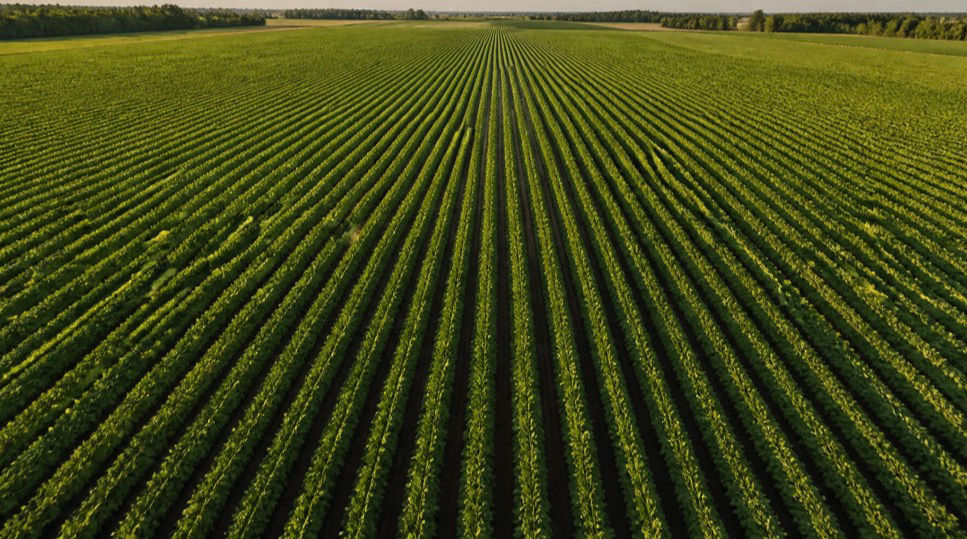
Emergence consistency is a critical control point for operational timing. In a stable system, plants emerge within the same narrow window. When emergence is staggered, the field stops functioning as a synchronized unit and starts behaving like competing layers of development.
Late-emerging plants remain at a structural disadvantage. They are shaded earlier, compete from behind, and rarely reach the same performance ceiling as dominant neighbors. More importantly, they disrupt management.
When multiple growth stages exist in the same field, application timing becomes fragmented. What fits the early emergers may be ineffective or damaging for the later ones. That forces the operation to manage toward the average, which is another way of institutionalizing inefficiency. Emergence synchronization improves timing, simplifies decisions, and keeps the crop aligned with the intended management sequence.

Building the Hardware for Input Processing
Early-stage biomass functions as the plant’s hardware. Plant size and health at stages like V6 in corn or the early vegetative stages in soybeans define much of what follows. This period sets sink capacity, including kernel rows, node counts, and pod sites the plant can realistically support.
If the crop is stressed or under-resourced during these window-setting stages, it down-regulates its own potential. The structural ceiling drops early. Late-season nitrogen or foliar intervention may protect remaining potential, but they do not fully restore what was lost during initial development.
This is another execution issue disguised as a late-season performance issue. Operations that build early biomass and structural capacity put later inputs into a system that can actually process them. Without that early hardware, returns narrow quickly. Strengthening the crop early remains a fundamental rule of workflow optimization.
Stress Tolerance as an Operational Buffer
Agricultural environments are rarely stable. Drought, heat, and pest pressure introduce constant variability. Early-stage development determines how much of that variability the crop can absorb before performance starts to erode.
A plant with deep roots and meaningful early biomass has greater stress tolerance. It has the reserves and structural capacity to continue through short-term stress without immediate reproductive loss. That creates operating margin.
A structurally weak crop has very little buffer. Minor stress events escalate quickly and trigger reactive, often expensive, intervention. Strong early development reduces that sensitivity and supports more consistent performance across soil types and weather patterns. This becomes especially important when maximizing input efficiency in a drought.
The Inefficiency of Late-Season Corrections
Many operations still follow a wait-and-see pattern. They respond after the deficiency is visible. In a biological system, that is usually a late response to an earlier structural failure.
Late-season rescue treatments are typically defensive. They may limit further loss, but they rarely rebuild lost yield capacity. By the time a nutrient deficiency or stress signal is visible, the crop has already absorbed the setback. Cost rises, return narrows, and the structural ceiling remains lower.
Early support is more efficient because it prevents those bottlenecks from forming. Once the crop enters reproduction with compromised structure, correction becomes inefficient. This is why reactive management consistently underperforms compared with well-executed early-season structure.

Operational Timing and Consistency
Operational predictability depends on crop consistency. When early-stage development is uniform and structurally sound, the rest of the season is easier to sequence and manage.
Canopy Closure: Faster early growth accelerates canopy closure. That suppresses weed pressure and reduces the need for additional herbicide passes.
Dry Down: Uniform plants mature on a tighter schedule. That improves dry down consistency, reduces drying cost, and limits the bottlenecks caused by uneven maturity.
Harvest Logistics: A consistent crop moves through harvest more predictably and typically produces a cleaner grain sample.
These efficiencies compound across the season. Labor demand is more stable. Fuel use is lower. Equipment strain is reduced. The result is a more controlled operating model.
Strengthening the Foundation
High-performing agricultural operations manage the season as a sequence of interconnected stages. Early season is not a passive period. It is the primary window for structural setup.
If time and capital are consistently being redirected into late-season fixes, the issue usually starts earlier. Review the foundation. Assess whether root architecture can support the intended yield objective. Assess whether emergence synchronization is tight enough to support precise management. Assess whether early development is creating real stress tolerance or only exposing the operation to more reactive work later.
Early structure determines long-term performance. Reactive management increases inefficiency. The more stable path is to build the system correctly at the beginning and reduce the need for correction later.
To explore how structured systems can improve operational consistency, consider reviewing our agriculture-specific pricing and strategy plans.


Comments